
Tashkent is the capital of Uzbekistan
Tashkent is the capital of Uzbekistan.This city is known as the city of friendship,brotherhood and of course bread. In ancient China it was called as “Shi”(like a word “Tosh”).In Iran and Sosanid sources the city is mentioned as “Choch”.
Currrent name Tashkent acquired in XI century.Tashkent was conquered by arabs(VII century),Turkish khaganate,khorezmshakhs,mongols and russians.
In 2007 Islamic conference announced Tashkent to be “ the capital of friendship and Islamic culture”.
The city is more than 2200 years old.
Tashkent is not only rich for its history but it also is a trade-economic and cultural capital of Republic of Uzbekistan.Tashkent is a huge megapolis with the population of more than 2,5 millions, traced with the meshwork of straight and wide streets and avenues.Decorated with “Emerald Placers” of parks,squares,gardens,penetrated with crystal threads of fountains…
This is a wondrous city-embodiment of that modern elegance,which is incident to many capitals of the world,but since being eastern city Tashkent has its own original color.It exquisitely unites medieval buildings,just as if they appeared from ancient eastern fairytales,dainty European architecture,left from the times of Turkistan,standard concrete “corobas” from Soviet era,and finally shining high-rise buildings from glasses and concrete-carcasses of modern business-centres and banks- just like the evidence of new era of independent Uzbekistan.
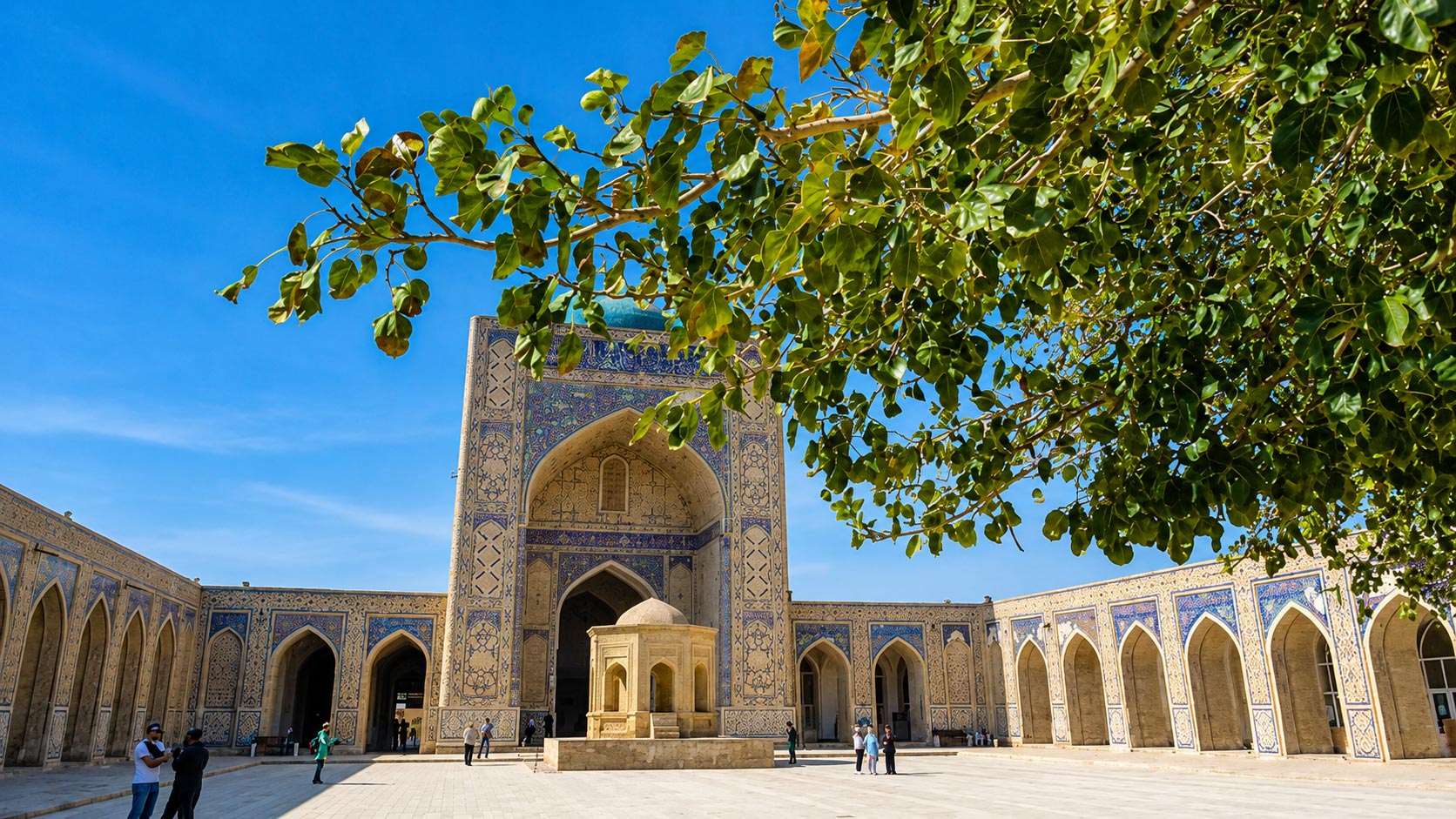
Madrasah Muya Muborak and mosque Tillah-Sheikh
Madrasah Muya Muborak was built in XVIII century by Kokand governor Mirza Akhmed Koshbegi. Memorial is situated in front of Madrasah Barak-khan (XVI) by the eastern principle “Kosh”( “eyebrow”)the portal of one madrasah is situated right in front of the portal of another one.Madrasah Muya Muborak includes summer terraces (which are called “aivan”)-columned and brumal domed mosque-cathedral mosques of Tilla-Sheikh(“Golden Sheikh”).
Tilla-Sheikh mosque- fore and aft building, which is rectangulary planned and it is covered by 12 domes.Entry bay is separated by bulkheads from the quadrate prayful hall.There are brumal and summer placements for prayers,aivans,low minaret,utility rooms and library in the yard of mosque.In addition the mosque is decorated with toreutic mihrabic alcove,called “minbar”(throne,where prayers are read during Namaz).
Nowadays,in a hall of the library in a special safe,where particular temperature and moisture are maintained, is kept famous Osman’s Quran dated back to VII’s century.
The legend of Muya Muborak
According to the legend,the hair from the head of the prophet Mukhammed is kept safely in the library of Muya Muborak-which is the holy relic of muslim people.It has been stated that from this issue appears the name of madrasah-Muya Muborak-which means “hair of prophet”.
Madrasah Kukeldash
Madrasah Kukeldash is situated in the heart of ancient city of Tashkent on « Chorsu » square.Madrasah was built in XVI century by the vizier of Barak-khan and Dervish-khan sultans.The vizier had a nick « kukeltash » which means « foster brother ».Dervish-khan was foster brother of khan.In XVIII century in the madrasah caravanserai for travelling merchants was arranged.At that times Kukeldash Madrasah was one of the giant madrasah’s of XVI century.As many other Madrasah’s Kukeldash was built from brick,by the following principle : large internal yard,surrounded by cells-khujjars(there are rooms for living,for lessons and mosque).In XIC century madrasah was the fortress of Kokand khans.Till 1865 madrasah Kukeldash was the place of public decimation :women charged with adultery were thrown down from the top parapet of the central portal to the stoned platform,in order to strengthen national moral.Nowadays renovated madrasah is the operational and accomplishes its direct duties :students live and study there.Moreover,believers come here on Friday prayers.
Mausoleum of Khazrat Imam
In one of the oldest regions of Tashkent,which has the name of Sebzar,there is a square with the whole ensemble of hictorical-architectural sights.It was forming during several centuries and is called-Mausoleum of Hazrat Imam.It is considred that,the ensemble was forming around graveyard of pioner preacher of Islam Kaffal Al-Shashi,the square was named after him as Khazrat Imam,which means « Saint Imam »
Saint Imam Kaffal Al-Shashi
Al-Shashi was born in Tashkent,studied in Termez,Bukhara and Samarkand.He was considered to be spiritual continuer and heir of such great islamists like : Mukhammad at-Termizi and Imam Al-Bukhari.Many times he piligrimaged to Mecca,visited Hejaz,Damascus and Baghdad.While travelling around the world he met up with great and famous muslim scholars,demonstrating his great knowledge in all spheres of holy transcripts.After death his gaveyard was considered to be a holy place.However,only after 600 years,above his grave was constructed mausoleum.On the main facade of the building there is a poetry inscription,where names of architect,calligrapher and all of people who took a part in construcion of mausoleum,were mentioned.
Place of worship
Tomb of saint attracts and delights with its magnificient architecture.As long as Mausoleum was the place of piligrimage,it was formed for strangers to live there in -Khanaks.Besides crosshatch hall,graveyard includes khujir,located in three tiers,which served as cells for piligrims.Ordinary tourists can easily find hotel in Tashkent near to the mausoleum.Despite the fact that the architecture of the building is quite massive it looks pretty dainty,due to blue dome, which was built on a rectangular cylinder.The grave is located in the alcove of western side of tomb.Still here are thousands of piligrims every year,they come to get an advice and blessing from the saint.Close to mausoleum there is an Institute of Islam named after Al-Bukhari,which is accomodated in the building of former mosque « Namazgakh ».It was elevated in 19th century and decorated with magnificient national carving and signed with traditional decors.
Maintance of traditions
Mausolem of Khazrat Imam also includes the building of Spiritual guidance of muslims,from all Uzbekistan,near to which Dzhuma-mosque is situated,built in 19th century.In front of mosque there is a library with affluent collection of spiritual litrature,which includes rare manuscipts with illustrations,referred to 16th century.Among the library system collection there are unique samples of eastern calligraphy,affluent editions of Quran,which were presented to the Spiritual guidance by leaders of foreign Islamic countries.
Palatial Friday mosque Dzhami comes out as culmination of this historical complex,which was built nowadays.It is decorated by magnificient turquoise domes,which were elevated in best traditions of Central Asian architecture.While continuing the discovery of city’s architecture,it would be good to visit palace of prince Romanov,modern style of which is unusual to Central Asian architecture.
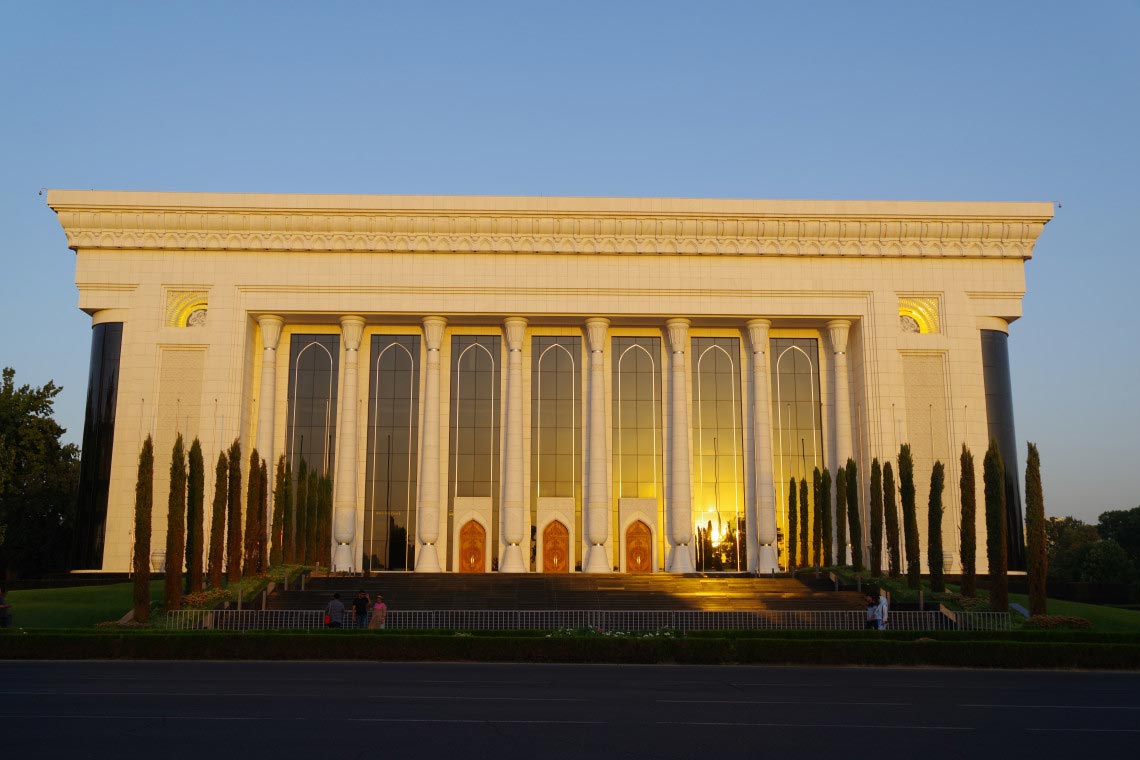
Madrasah Barakkhan
Madrasah Barakkhan-is religious complex in Tashkent.It was formed during XVI century from buildings,which were built in different times.Complex consists of mausoleum and khanaki.Mausoleum was built first,it is situated in eastern part of today’s complex. Second was the two-domed mausoleum-khanaka,which was built in 1503 in honor of Tashkent’s governor Suyunkkodzha-khan(Ulugbek’s grandson).It is well-known for being the centre of Spiritual guidance of all muslims in Central Asia.It also includes affluent library of eastern manuscripts.In the library’s special place of Barakkhan madrasah,famous Quran of khalif Osman-Osman(Ottoman) Quran has been kept.It is the primary source of holy islamic book,which was written in the middle of VII century.Ancient manuscript which is consisting of 353 parchment sheets,of very large size with original text of Quran,was kept for hundred years in treasuries of khalifas’(subsequently in cities like Medina,Damascus and Baghdad).In times of Temur’s reign Osman Quran was moved to Uzbekistan from Baghdad,after that (in XIX century) it was sent to Saint-Petersburg,where it was kept till revolution.Later Quran was imported from UFA to Central Asia.In the mids of XVI century,the complex,reconstructed into madrasah,was named after ruler of that time,Navruz Akhmed-khan,aka Barakkhan. The design of Madrasah’s portal is not usual for Tashkent.Its body is completed in the form of niche- kolab-kori ;lunettes and columns are decorated with carved brick and different mosaics.The name of architector who renovated kolab-kori in 1955-63 is Usta Shirin Muradov.
Sheikh Zainiddin’s mosque (Kukcha mosque)
Sheikh Zainidddin-Bobo was born in Baghdad in 1164.His father was Shakhobiddin Sukhravardi-founder of Sufi order sukhravardia,poet and sheikh,leader of Baghdad Sufis.In his youth Zainddin was sent to Tashkent to spread and preach famous gospel of his father.Zainidddin settled down in Kukcha-one of the fourth Tashkent’s regions,where he spent all his life.He was reading lectures,devoted himself to enlighment of population and development of spirituality. Most of his time he spent in cell-as so called chilla-khona,where he prayed about people’s well-being.At hard times,when Maverannahr was in ruins after mongols’ intrusion, whereas Tashkent was literally rebuilding again,Zainiddin played a great role as a spiritual mentor of the whole nation. For his strident intelligence,erudition and wisdom people respectfully called him as “bobo”- which means “grandfather”.Revered by all,Sheikh Zainiddin-bobo ended his life at the age of 95 years old and was buried on the territory of cemetery Veloyat.It is said that his descendants are still living in Tashkent.In memory of Zainddin Bobo,at the end of XIV century,there was built a mausoleum in Kukcha,what was ordered by Amir Temur. However,what attracts people more is not the mausoleum itself but ancient cell in it-exactly that “chilla-khona” which was the main shelter of Zainiddin-bobo.This monument of ancient architecture dated back to XII century,it is the oldest funcionating building in modern Tashkent.Primary brickwork of cell is plastered,and the floor is paved with new material,but under these layers-there are real ancient walls ,which remember the events of Zainiddin bobo’s times.Interestingly cell is not remarkable for its antiquity.
Secret of Zainiddin Bobo’s cell
At the beginning of 90’s of XX century,during measurement and maintance of buildings,it was found out that cell is constructed as ordinary observatory-construction for observing astronomical phenomena.Underneath and at the top of cell there are special holes,which are not at the same axis,but line which unites them,lies within Tashkent’s meridian plane.This line forms horizontal angle,which is the highest point of sun rising above Tashkent on summer equinox.From the underneath of cell once in a year,it is possible to observe sun in daytime and other celestial objects at night.Niches in the walls of this room show all directions of eight compass points.This cell is the unique place equipped like an observatory.Thus, one of the mysteries of that times is figured out-why people called this place as “Hill of Wismen”.There are a lot of gossips and myths about that cell-it is said that once there was an underground passage which led right to the Mausoleum of Kaffal’ Shashi.
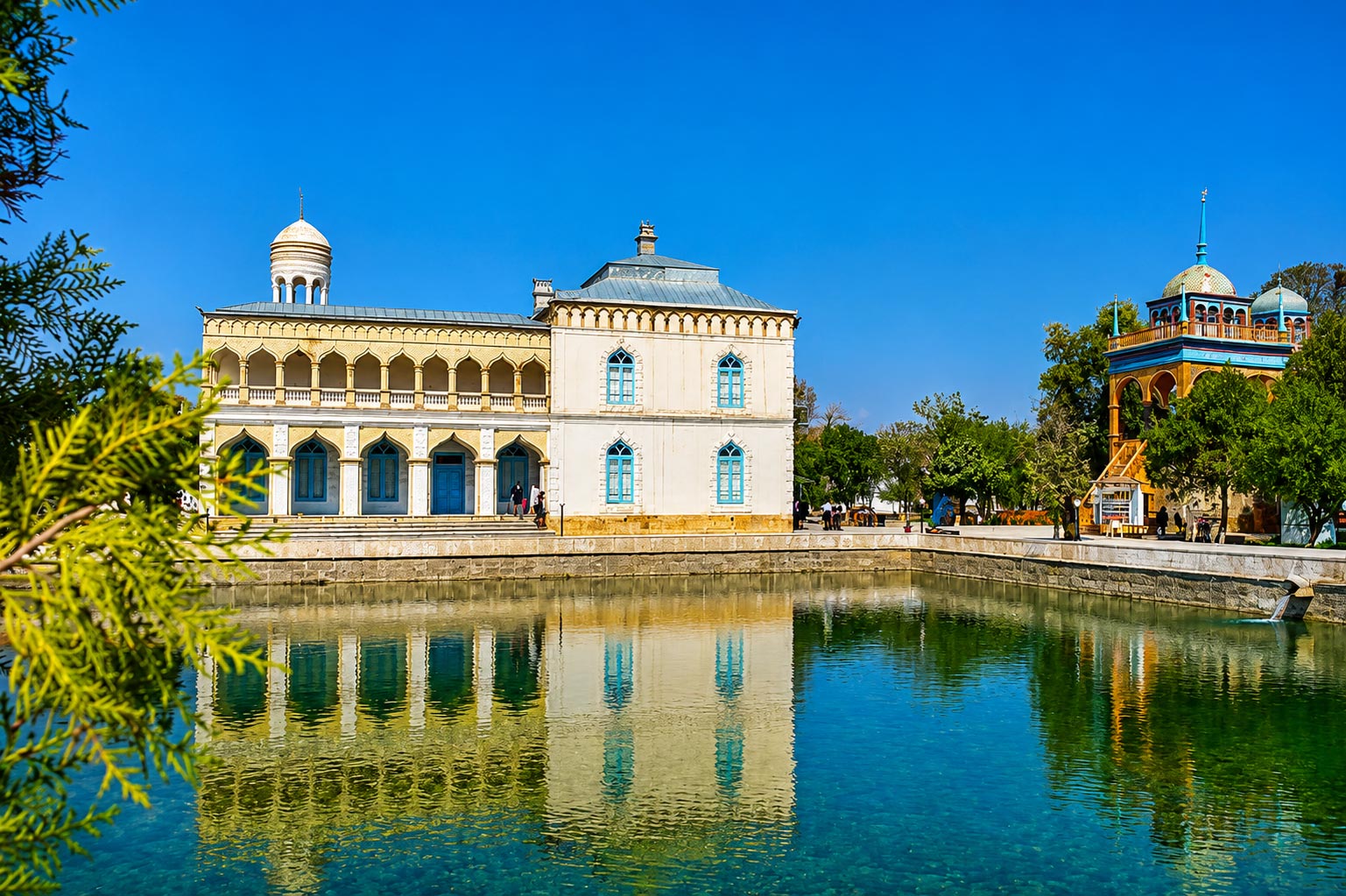
Mosque of Khodzha Akhrar Vali
Tashkent Juma-mosque of Khodzha Akhrar Vali-is the only columnded(yard) Friday mosque in the capital of Uzbekistan.Constructions of this kind of mosques was often used in XV-XVI centuries.Getting ready to move,Ubaidulla Akhrar-the greatest master of Sufism,leader of Muslim clergy and descendant of prophet Mukhammad,ordered to build a big Friday mosque and madrasah in ancient Tashkent makhallya Gulbazar.The first building of Tashkent Juma-mosque was built in 1451 by the order of Sheikh Ubaidulla Khodzha Akhrar(1404-1490).
Inside of the mosque vaulted galleries were built with cells around long yard,takhoratkhona-where muslims perform oblution before prayer.Mosque’s trim was very ordinary.In 1868 the mosque was significantly damaged by the earthquake.In 20 years,in 1888 it was rebuilt with the help of Russian imperior Alexander III from the military contribution of Bukhara’s Emir,after that it was called Imperial mosque.
Zangi-ata Ensemble
Zangi-Ata(“brown father”,”dark-skinned”)-a nickname which sheikh get because of his skin colour.This great sufi was very famous when he was alive (end of XII-beginnig of XIII century) and he belonged to notable arabs.This is the resting place of Al-Khodzha,aka Zangi-ota (dark-skinned)- fifth murid of greatest sufi,founder of “Khodzhagan” devoted to Khodzhi Akhmad Yassavi order and spiritual student of famous mystic poet Suleiman Khaki-ata Bakirgani.His real name was- Aikhodzha ibn Tashkhodzha ibn Mansur and in his everyday life he was shephered,and following to the tradition of Sufis he helped people to survive in hard times.He was not only theologician but also respectful wise man.The construction of mausoleum was started by the order of Amir Temur after the death of sufi in 1390 and it was finished fast.Till nowadays the grave was never opened,hence this means that white-marbled tombstone with Kufi inscriptions,and the construction itself are indeed authentic and refer to the times of Amir Temur’s reign. Later,at the times of Ulugbek’s reign(Amir Temur’s grandson)(1409-1449) new decorated peshtak-central entrance was built.Today Zangi-ata mausoleum is composite part of architectural-religious complex,which unites,besides saints tomb, huge garden,madrasah,funeral mosque and minaret.
Just in hundred metres from Zangi-ata mausoleum on an adjacent cemetery there is another cult place of memorial complex- Anbar-bibi mausoleum,who was famous sufi’s spouse and companion.According to the legend,Anbar-bibi is saint patroness of all women and children,that’s why piligrim ladies come to her graveyard to pray for long-awaited offspring.
Time hasn’t spared saint’s mausoleum ,however it was rigorously rebuilt by ancient samples.People say,that Zangi-ota bequeathed parishioners to visit his wife’s tomb first and only after that to come to his tomb.
Nowadays,memorial complex Zangi-ota is justly among the most significant masterpieces of regional architecture end of XIV-XV centuries and represents huge historical and artistic value.
Kaffal’ Al-Shashi mausoleum
Abu Bakr ibn Ismail Al-Kaffal’ Al-Shashi(903-975)- Islamic scholar.Kaffal’ Al-Shashi,known as Khazrati Imam was born in Shashi region(Tashkent now).He got education in his own native city,afterwards he improved his knowledge in centres of Islam of that times- Bukhara,Samarkand,Termez.There he studied works of greatest scholars and muhaddists of Imam Al-Bukhari,Mukhammad at-Termizi,enhanced knowledge in Islamic jurisprudence and other sciences.Sometime Abu Bakr Kaffal’ Shashi had lived in Samarkand,then visited Arabic cities- Khidzhaz,Baghdad,Damascus and repeatedly worshipped in holy Mecca.
Taking part in discussions with greatest scholars of his time and demonstrating his wide knowledge in many spheres of science,he deserved authority and profound respect among scholars and usual people.According to all Arabic sources,theologician from Shash (ancient name of Tashkent) was called as “Imam Al-Kabir”,which means “Greatest Imam”.By the statement of Arabic bibliographer of XIII century ibn Khallikon,there were no individuums in all Maverannahr who could be with Kaffal’ Shashi.
He was a missioner,one of the first preachers of Islam in Tashkent,preaching shafiotism.
He was interested not only in theology and jurisprudence. According to historical sources,he was
interested in poetry and he was brilliant master in making of locks and keys,for what he got a nick
“Kaffal’” – “Locker”. According to ancient legends,Imam Al-Kabir made lock with a key
weighting 0.5 grams ,knew 72 languages and translated Old Testament(Toru) into Arabic language.
Abu Bakra ibn Ismail Al-Kaffal’ Al-Shashi passed away in X century and was buried on the territory of current complex “Khazrati Imam”.His graveyard was destroyed by winds and time but soon rebuilt in XVI(in 1542) by the descendant of Temurids,architecture Gulam-Gusein.
Mausolem is an architectural piece of XVI century,which has rectangular form, and is decorated with big blue dome.The building is made of tiled red brick and decorated with majolica with historical inscription,which contains names of all masters-architectors and data of construction.Windows are decorated with traditional for Tashkent ganch panjara.
Kaffal Shashi’s Tomb represents rare variety of multi-chamber mausoleums-khanaka with assymetric layout.Khanakas were complex constructions,including cells,mosque,tomb,oshkhona(kitchen) and other placements. They were targeted to give a shelter for piligims in cells- khudzhars.
Tombstone “Kaffal’ Shashi”,from both sides of which chillakhona adjoins,is on the top niche of mausoleum.Right here,a little beneath there are graves of “Great Imam”’s sons –Mukhammad at-Shashi and Nizamiddin Shashi.Mukhammad Nomi,who came from Baghdad and who lived in Tashkent ,his father-Makhmud Nomi and son-Khodzha Kalan are also buried in mausoleum.To the south from main building in little yard there are later burial places,which took name “sagana”.Close to the entry of mausoleum are buried Khafiz Kukhaki and Ulugbek’s grandson Ali Kushchi,who was a student and adherent of great scholar.From left side of entry there is a graveyard of popular herat poet Zainiddin Vasifi- mentor of Barakkhan.
There is also a house near mausoleum,where Khodzha Akhror Vali lived-follower of Kaffal’ Shashi and Bagautdin Nakshbandi,who thought that believers shouldn’t ask for charity,but should work and earn money by their own work.Khodzha Akhror was master of Sufism and statesman.He was buried in Samarkand.
Tomb of the greatest Imam is very popular and revered by all muslims of the world.It became a place of worship for believers,as for the whole territory of sebzar side of city ,it get a name of Khazrati Imam.This monument has a great historical and artistic value and is included in Khazrati Imam ensemble.
Yunus-Khan Mausoleum
One of the grateful periods in architecture of Uzbekistan was era of Temurids.In that ancient times there were built a lot of wonderful monuments of culture,particularly- mausoleum of Yunus-khan Mogolistan,which became part of architectural ensemble of Sheikhantakhur.Mausoleum of Yunus-Khan Mogolistan,is situated in Tashkent on the territory which belongs to Islamic university not far away from sheikh Khovendi at-Takhur’s mausoleum.This is one of the two monumental buildings of Tashkent of XV century,which were kept till nowadays.Actual dates of construction are unknown,but it was built not earlier than 1487(death of Yunuskhan) and not later than 1502. It is considered that construction was done by sons of governor. Yunus-khan was descendant of well-known Chingiz-khan.What is more interesting is that he was a relative of Mirzo Ulugbek.Yunus-khan was born in 1416. His life was hard.Long-term deportations to Iran played a significant role in his life.It was a hard time for future khan of Mogolist Ulus.He was talented in poetry and music.He played instruments,wrote poems,learned literature,Arabic and Persian languages,his theology and governance played significant role in the history of Uzbekistan.Mausoleum of Yunus-khan Mogolistan has no analogues among all monuments of Uzbekistan.It looks like a huge T-shaped khanaki.Mazar served as shelter for piligrims and had special cells,which were situated on both floors. From the front side it is decorated with colonnade,calligraphic Arabic pattern.,wooden grids and “girikh” style ornament.This style is called- ascetic and mediterranian.And below the arch it is possible to observe “mukarnas”. “Mukarnas”- is a folded arch in the form of stalactites.In 15 century front doors could sound melodies.Masters and architectures.who built fascinating mausoleum ,inserted ancient musical instruments called “chang”, so that when doors were opening and closing they produced nice melodies.The front had to be replaced in XX century because its bad condition.Mausoleum of Yunus-khan was built for burial of great leader.mausoleums keeps a lot of different mysteries and secrets in it.And it is considered to be unique architectural monument in Uzbekistan.
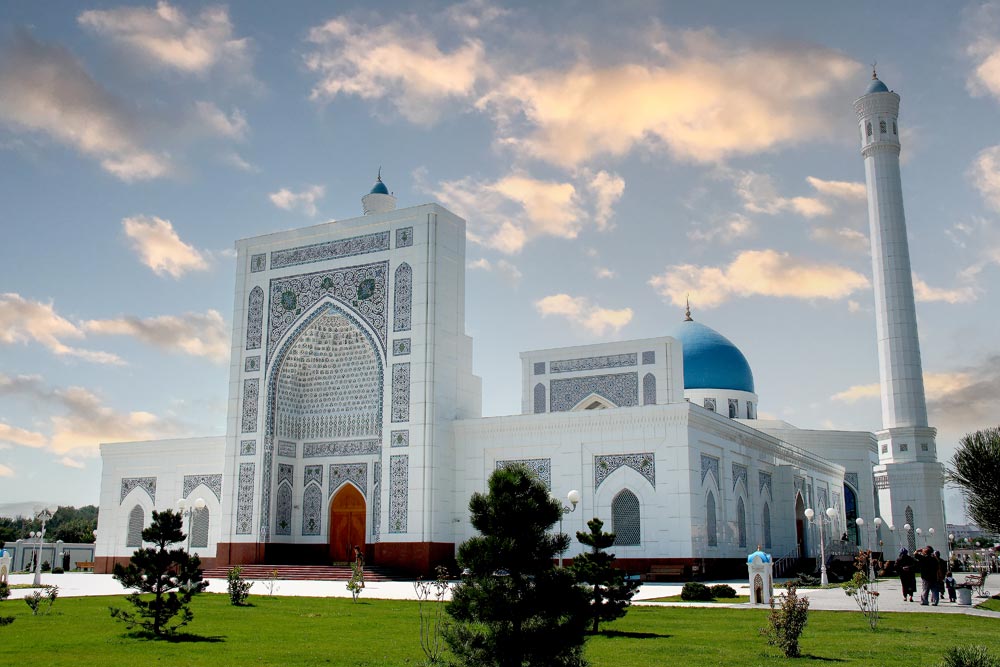
Minor mosque (white pearl)
Minor mosque is one of the greatest spiritual centres of muslims of Tashkent and whole Uzbekistan.It lies on the shore of canal Ankhor,promenade of which was improved in last months.The building of mosque is constructed in best eastern and uzbek styles, has two minarets and dome of celestial colour. Internal part of mosque is decorated in “naksh” style and mikhrab is decorated not only with inscriptions from Quran but also with hadiths.Mosque is targeted for more than 2400 people.After opening,it has become one of the biggest spiritual centres for muslims of Tashkent and whole Uzbekistan.Unlike its other stoned brothers,Minor mosque is lined with snow-white marble,that’s why people of Tashkent often call it “White mosque”.In a bright sunny day it seems that moswue is shining from inside.Buildings with two minarets are made in a typical uzbek style,reminding some elemnts of Samarkand’s Registan(especially azure dome).As for internal furniture,it speaks about young age of construction.But such conclusion is made based only on the usage of modern decorating materials.In other respects ,Minor includes all those traditional for Central Asian mosques clay-gypsum carving,many frescos and mikhrab(niche,which guides the direction to Mecca),decorated with quotations from Quran and sayings of prophet Mukhammed.By the way, Tashkent mikhrabs are the accurate copy of Samarkand’s mikhrab.There is a two-floored praying hall and two terraces,gently welcoming traveler too get into internal yard decorated with carved wooden columns.It includes all good conditions for visitors.There are special rooms for ablutions,which are equipped with modern gadgets.
Sheikhantakhour ensemble
Ensemble Sheikhantakhour – is an architectural complex, centre of which is Mausoleum of sheikh Khovendi at-Takhour (Sheikhantakhour).One of the important architectural monuments of Tashkent,Uzbekistan.It is situated in the centre of modern Tashkent in quadrate,which was formed by Alisher Navoi,Sheikhantakhour and Abdulla Kadiri streets.Memorial complex of saint sheikh Khovendi Takhour,who lived in XIV century,consists of three buildings :Khovendi Takhour’s tomb(XV-XIX),tomb of Kaldigoch-bey(XV) and mosques.In both tombs there are place for ziyaratkhona(places where prayers are read) and gurkhona(grave).
Sheikh Khovendi At-Takhour’s biography
Sheikh Khovendi at-Takhour was born in XIII century.He was a Said,meaning that he belonged to the Quraysh tribe(Qurayshs were leading tribe of ancient Mecca,which was the tribe of prophet Mukhammed),native tribe of prophet Mukhammed.His father ,Sheikh Omar was consecrated sufi,follower of dervish Khasan Bulgari.He came to Tashkent with only one aim to spread Islam.Soon Sheikh Omar moved to mountain village Bagistan(village in Bostanlyk region of Tashkent)there he spent rest of his life.Where Seikh Khovendi at-Takhour(Sheikhantakhour) was born.Young Sheikhantakhour consecrated among dervishes of Yassa town,where already cult of sufi Sheikh and founder of Khodzhi Akhmed Yassavi order was disseminated.After extended period of travelling around Maverannahr,he came to Tashkent,where he was remembered as “wisest ever”. Sheikh died somewhere between 1355 and 1360 years.
Legend about construction
According to legend,when countless Jungar hordes were coming closer from east,people started running in a panic and left their homes.Tolebi did not leave his home.Jungar’s leader ordered to bring him and asked Tolebi whether he didn’t afraid of anything.Tolebi said that he did not want to destroy his yurt and devastate swallow’s nest with newly born little birds.Tough Jungar was impressed so much that he did not harm neither this righteous man nor his family.Since that time Tolebi is known as Kaldirgoch-bey, “Owner of swallow”.Subsequently,Kaldirgoch-bey inspired people to revolution against Jungars, after their banishment,he was chosen as vicar of Tashkent.After his death he was honourly buried near saint Khovendi Takhour’s grave.
Chronology of building architectural monuments and constructions on the territory of complex
First was built mausoleum of Sheikh Khovendi Takhour from Bogustan(Sheikhantakhour),who died in 1355.
At the end of XV century there were built chillakhona,mausoleum of Kaldirgach-bey,mausoleum of Yunus-khan Mogulistan.In 1892 there were built chortak and Ishan Kuli-datkha madrasah,which are illustrated.In 1908-1910 Khodzhimat-Ishan from Namangan constructed Aurat-mosque with minarets.
In 19143 minaret was built near Yunus-khan’s mausoleum.Besides that,on the territory of complex were built mausoleum of Kuktellik-ata (saint who cured whooping cough) and Kaba mausoleum.There also were several blocked framework mosques:Zandzhirlik mosque which was situated at the entrance of complex,and Garib and Said Azimbai mosques on the side of Yunus-Khan mausoleum.On the territory of Sheikhantakhour complex grew few 500 hundred years old summer chinars.Near to mausoleum of Kukchar-ata there grew elm-tree,which was covered with goats’ antlers.To the beginning of XX century on the territory of Sheikhantakhour complex there also were wireframed garden-houses-sheipans,oshkhona(dining room),chaikhonas(tea rooms),shops-dukans for selling flat bread and sweets,also circuses for performances on holidays.
Burial complex of Sheikhantakhour
Sheikhantakhour cemetery- is the most popular holy place of XVI age-old Tashkent.Local aristocracy was buried here.Burial complex started forming in suburbs,among wealthy townspeople’s estates.As the time passed, whole funeral complex was formed around Sheikhantakhour mausoleum.Complex along with town region got a name of Sheikhantakhour.Here were buried a lot of outstanding personalities who left a mark in the history of Tashkent.Till now there are only 3(out of 6)monuments of burial complex Sheikhantakhour.Apart from Sheikhantakhour mausoleum there are also Kaldirgoch-bey’s and Yunus-khan’s mausoleums.
Kaldirgochbey Mausoleum
Date of mausoleum complex of Kaldirgachbey’s construction on the territory of Sheikhantakhour complex refers to the first half of XV century.Building of Kaldirgochbey mausoleum has pyramidal dome,which is pretty unusual for Uzbekistan.Tole-bi(Kaldirgochbey)was a legendary judge from Dulat tribe,which run Tashkent during Kazakh khanate.Mausoleum was built in the first half of XVth century.Unfortunately the yard and décor of mausoleum did not remain as they were.Sizes:9,5×9,5 m,room:6×6 m.
Chorsu Bazaar
Bazzar-is the heart of any eastern city,epicentre of social life,supplier of the whole city.From time immemorial,bazzars arise on the crossroads of trade ways,along big city squares.They played significant role as main city places,where merchants,traders and ordinary people gathered to discuss important news,be aware of prices,hang out in cosy chaikhanas(tearooms),to try (pilav)plove and green tea. Main attraction events of the city were presented here-theatrical perfomances.Chorsu Bazaar – one of the biggest bazaars of Uzbekistan and Middle Asia,is situated on ancient side of Tashkent which is called “Eski shakhar”,on Navoi street.Chorsu bazaar was not famous for anything but being important part of the Silk Road.Ancient bazaar “Eski Dzhuva”(“Old tower”),more known as “Chorsu”(Chorsu-“four roads” or “four fows”)which is situated in Old town on the crossroad of four trading streets,all year round impresses with its colourful goods and architectural structure,breath of antiquity and national culture.Tashkent’s Chorsu Bazaar,which is more than hundred years always was on the main square of Eski Juva city.Significant number of eastern governors passed either by ride or on foot the old stomping ground of bazaar.While old bazaar constructions were collapsed and crumbled ,its traditional architecture remained the same-covered by domes of huge placements.In terms of dry and hot Asian climate it seemed to be the only way to protect from heat and dusk.It also has such significance because it is has been situated right in the heart of historical-architectural complex,dated back to XVI-XVII centuries-these are Kukeldash and Khodzha Akhrar madrasah,Dzhami(Friday) mosque.Goods in the modern bazaar are divided by the following order:
1)Products;2)handicraft rows;3)commodity market.First two sections are especially interesting,they are situated under the huge covered pavilion,most parts of which are adorned by domes in eastern style.There is the biggest dome in the centre,which reminds circus’s dome(the circus by the way is situated in the same region of Tashkent).There are countless rows of fruits and vegetables,household goods around it.To get the feeling of real shopping in Tashkent,you definitely should visit the oldest bazaar of city-Chorsu.Centuries before Chorsu was the most busy outlet in Cetral Asia since it was on the Silk Road.Worldwide known Chorsu specializes in everything from jewerlies,ceramic goods,national costumes to household goods and many other things.
Alay Bazaar (market)
Eastern bazaars impressed with their diversity.There were silk rows,where different silks from India and China were traded,also handicraft rows,where it was possible to obtain ceramic,copper,iron items,products from valuable metals and they only compounded that tiny part what eastern bazaars were rich for.Majority of old bazaars of Uzbekistan are located on branches of Great silk road and have very ancient history.Thus many khorezm bazaars have history,which goes back to VI-X centuries,some of Samarkand and Bukhara bazaars can also be referred to that period.Alay Bazar is considered to be one of the oldest bazaars of Tashkent.Supposedly it occurred in XII-XIII centuries on Oloy mountain,not as bazaar,but just as the trading place on the trading road which lied from Eastern Turkistan through Fergana valley.Mainly, it was a place for trading livestock and different kinds of meat.In XIX century this so-called “outlet” became a sterling bazaar,which was often visited by local people because it was located on the edge of Old town and regions. The most plausible story of Alay market was told by architect A.Ziyaev in a book called “Tashkent’s bazaars. Past and present”.State official government adheres to this version of events.According to Ziyaev’s book,bazaar was established in the second half of XIX century,when new Tashkent just appeared and started to extend to north from Square.Modern Alay bazaar has a bit different specialization nowadays.Plus its size is a way impressive than it was before.Nowadays there are dozens of grocery rows,offering eastern sweets and fruits.There are also shops which sell fresh meat,milk and pastry.Bazaar is also famous for its huge two-storey pavilion : this is one of the best places in Tashkent to buy silver and golden products.It is possible to buy here local vegetables and fruits,as for lovers of exotic there are rows with fruits which are not typical for Uzbekistan such as:bananas,pineapples,oranges,mango,kiwifruit and others.Various eastern viands are also sold here :navvat,kazinaks,parvarda,pashmak,sultanas,dates and many other things.Next to it there is a wide range of nuts:walnut,cashew nut,peanut,pistachio,also variety of pits:almond,salty apricot pits and etc.Part of provided goods grow and are manufactured directly on the territory of Uzbekistan,other part has been imported from nearest and furthest abroad.
“Islom-ota” mosque
Previously cathedral mosque “Islam-ota” was called as “Dzhurabek”.It is one of the oldest mosques of Uzbekistan.It is more than 300 years.In the middle of April of 2015 mosque was affect by fire.Repairement works took 9 months.Once it was reconstructed, territory of complex doubled in size.Now spiritual centre contains more than 1000 of believers.Mosque is decorated by central dome(22,1 m),huge minaret (36,65 m) and four small minarets (10,82 m).Ceilings and walls of mosque are booked up with suras from Quran.After reconstruction,according to general public’s suggestions and willing,it was decided to be renamed.Now it bears the name of first president of Uzbekistan-Islam Karimov.Facilities for disabled people,newest air purification system,air-conditioners are also established in the building.There are also vacation spots on the surrondings of mosque.Mosque includes functioning library where new books,unique manuscripts and limited editions are available.
Sacred Heart Cathedral
Sacred Heart Cathedral is a catholic church in Tashkent.Cathedral of Apostolic authority in Uzbekistan.
History
The construction of church in Tashkent was started in 1912 by priest Justinas Bonaventūra Pranaitis’s initiative based on the project of popular polish architect Ludovic Panakevich.Builders of the church initially were catholic soldiers who served in Tashkent,later the construction works were continued by war prisoners,kept in Tashkent,among whom there were highly qualified engineers,sculptors and masons.From 1925 to 1976 in unfinished building various ventures,dorms and warehouses were located.During the period when church was misused ,all sculptures were stolen and destroyed.On October 22,2000 renewed building of Sacred Heart Cathedral was sanctified by archbishop Marian Oles-apostolic nuncio of Kazakhstan and Middle Asia from 1994 to 2001.Currently Sunday mass is conducted in four languages :English,Russian,Korean and Polish.Nowadays there are 3 Franciscan-monk priests,1 Franciscan-monk and bishop of Apostolic authority in Uzbekistan Ezhi Matsulevich,who serve church.Cathedral’s unique interior. Marble and granite lining make hall look more solemnly.Doors and exclusive furniture are made of special kinds of wood.Front gates to the crypt,wonderful chandeliers in a main hall,unusual luminaires,candlesticks,candelabrums,gothic style window bars,doorknobs,railings-are all work of parishioner-Vladimir Pillipyuk blacksmith.Crypto-chapel is the oldest place which was built before 1916.Holy Mass is being held there on weekdays.Hall of St.Ioannes Paulus PP. II was named after Patriarch of Rome (1978-2005),who has a significant contribution in resurgence of Catholicism in Uzbekistan.Meetings and lectures are being held there.The biggest hall on the first floor is hall of St.Anthony of Padua.It is decorated by mosaic panel which symbolizes secret of Sacret Heart and monument of St.Anthony of Padua.
The Evangelic-Lutheran church
The Evangelic-lutheran church-is the Lutheran church in Tashkent.Eparchy-Evangelic-Lutheran Church of Uzbekistan.Mass in this cathedral started from October 3,1899.Kirche’s building was built by Lutheran community of the city with funding of I.I Krause based on the project of architect A.L Benau.It was used as a warehouse in Soviet times,at the end of 1970 year the building was forwared to Tashkent Conservator, once been restored it was used as opera studio of conservatory.Right at that times there was set an organ in that building where organ music concerts were regularly held.In 90’s the building was repeatedly handed over to renewed Lutheran community of city,though the number of Lutherans in Tashkent of that time was very small.Pastor’s position was taken by Justus Justusovich Yurgenson on the 26th of September 1892.Cornelius Vibe was the leader of the church until 2015.
Temple of St. Alexander Nevsky
St. Alexander Nevsky temple –is an orthodox temple of Tashkent and Uzbekistan Eparchy of Central Asian metropolitan diocese of Russian orthodox church, located in Tashkent on the territory of cemetery.Bears the name of Saint Alexander Nevsky(Alexander Yaroslavovich Nevsky- Novgorod’s prince,grand prince of Kiev,grand prince of Vladimir,commander of Saint Russian orthodox church).St. Alexander Nevsky’s cathedral is the oldest orthodox church of Tashkent which came to present days.It was located on the territory of Botkin’s cemetery in Tashkent and it was built in 1902-1905 years on the ministry fund .Commercial adviser Nicolai Ivanov made a huge contribution to the construction of temple.He lived neighbouring with cemetery and was highly respected by Eparchy of Turkestan.He donated to church a number of times.Especially with help of his funds there was constructured golden Iconostasis for the temple.Construction of the temple was carried out by engineer Smirnov based on the project of L.Burmeister, as for consecration it was done by arch-priest Konstantine Bogorotsky.On the weekdays temple was visited by 20 to 30 parishioners,whereas on holidays there were more than 200 believers.In post-revolution period church played a significant role in the life of orthodox denomination of Uzbekistan.Part of church’s members served to Soviet Authority,while others were against it.Thus in 20’s church was occupied by renovators-followers of new Christian movement ,which occurred after February revolution of 1917 year.Orthodox parishioners worshiped close to chapel honoring icon of God Mother.After the war temple was returned to the orthodox church.Over the years the church had suffered from 1966’s earthquake and fire,what splited the building crisscrossed.But inspite of it the building wasn’ t collapsed and moreover it was restored.Inside it is decorated with frescoes bearing images of saints’ faces,angels and archangels,countless icons in golden frames.Currently, appearance of temple does not differ from its initial appearance,only façade was painted in white-blue ,repeatedly lined with marble, iron bars are also added.Arch-priest Nicolai Rybchinsky has been the prior of the church for many years.Cathedral’s unique interior.Significant contribution to the temple was made by Nicolai Ivanovich Ivanov who funded the construction of new iconostasis.Iconostasis was wooden,but beautiful,refined and golden.Church’s project belongs to engineer L.Burmeister,foreman-is a military engineer captain F.V Smirnov.Architecture of this temple makes it the most amazing masterpiece of church architecture.Inside,it was plastered with ganch and painted in turquoise colour ,as for the ceiling it was painted in white.Floors were made of cement bars, while altar’s floor was painted with oil-paints.Solia was also made of wood and painted in grey.From western wall over front doors there were choirs for choristers.On the front façade of building from both sides were built two towers for bells.3 bells were casted for temple,weighting 0,25 tonnes.The biggest one weighted 196,568 kilograms.It is known that bells were casted by master Polishenko in Tashkent.
Holy Assumption Cathedral
Holy Assumption Cathedral is orthodox temple of Tashkent Eparchy.New building of cathedral was built of mud-bricks an consecrated in honor of Great Martyr and healer Saint Panteleimon,in return of old church building of Saint Panteleimon,which was build in 1817 on the territory of Tashkent hospital cemetery.There was an issue about church’s extension.There was no place for people who came to worship.It was repeatedly reconstructed on the funds of people.Governor-general fon Kauffman donated 3000 roubles on its construction.However, the greatest donation was made by Tashkent trader of first guild Dmitryi Zakho,who consequently became churchwarden for 15 years.Cathedral’s fate did not differ from other similar constructions of Soviet rejime.Till 1945 it was given to hospital as warehouse and garage.Only in the end of war,exactly in 1945 year,the building started to carry out its initial funcions.It was restored in 1960.Chapel and domes of cathedral were rebuilt in 1990.Half a century later of last big reconstruction,cathedral is expanding and renewing again.In April 11,2009 an important historical event took place in the life of Central Asian Eparchy: “voices” of 13 new cathedral bells sounded in Tashkent .And they were heard beyond the bounds of cathedral.On the 10th of November during his visit to Tashkent Patriarch of Moscow and all Russia Aleksei III worshiped in Cathedral.By his visit cathedral had obtained new paraphernalia.In the building where worships are held,ancient icons in golden frames hang,also it is possible to see here an ark with particles of a tree of Life-giving Cross,holy relics of the Kyiv Cave reverend fathers and other relics.Relics of Holy Assumption Cathedral are:
- Iveron Icon of the Most Holy Theotokos.It was written in 1904 in Russian Saint Panteleimon’s abbey on holy mountain Aphon.
- Icon of the Repose of the Virgin.It was brought in 1904.
- The icon of the Mother of God “Quick to Hearken”.It was written in 1984 in Russian Saint Panteleimon’s abbey on holy mountain Aphon.
- Fedorov icon of Holy Virgin Theotokos.It was presented as a gift by Saint Patriarch Aleksei I to the cathedral’s consecration in 1957.
- Saint Basil’s icon,archbishop of Caesarea Cappadocia.It was brought in 1904.
- St Nicholas the Wonderworker’s icon.It was written about 1884 year.It was presented as a gift by Saint Patriarch Aleksei I.
- Icon of Saint Panteleimon,It was brought in 1897 from Ashgabat for Tashkent’s Saint Panteleimon hospital church.
Tashkent’s Chimes (Memorial plaque on the grave of A.Aiesnstein)
High tower with clocks is one of the most well-known symbols of Tashkent.If monument of Amir Temur is considered to be initial space lattice coordinate of the city,The Chimes are then considered to be time coordinate of post-military life,are memorial monuments of soldiers who died in World War II.430 thousandsof soldiers died in war.And to a memory eternal of soldiers who passed away in war,chimes in ball drops salute every 15 minutes,counting time of peaceful times of new life.
History
There is an amazing story about Chimes: I.A,Aizenstein who was clockmaker from Tashkent,brought the mechanism of tower clocks as a trophy from Germany after World War II.Those clocks were on the tower of City hall in Königsberg,East Prussia.Yhe city hall was destroyed,however the mechanism of clock was in a good condition.Aizenstein suggested and idea to build chimes in Tashkent.Local administration agreed and the tower was built according to the project of winner.Life goes on in the city of almost 3 million people,children are growing up,but heroic deed of the soldier who gave his live in the name of pure ideals of humankind against plague of fascism,will always be remembered by generous citizens.Nowadays complex consists of two towers,which unite aesthetics of past and the dynamics of present.Both towers combine modern and traditional elements of uzbek art.
Landmarks
There is a jewelry exhibition hall in complex,where ancient and modern jewellery items made by masters who belonged to famous dynasties of jewellers,are represented.In old section there is an antique shop,which offers visitors unique collection of traditional uzbek handicraft art and antique.The collection includes a colourful set of traditional costumes,suzani,various items made of wood,metal,ceramics,which were made by masters of different art schools in Tashkent and Kokand.Moreover twin-towers include exhibition of modern artists and designers of XXI century.Following items refer to them: fabrics,suzani and clothes,created by young masters who used restored ancient technologies.
Mass graves
The monument of national memory in honor of the soldier-liberator from fascism (“Mass Graves”)is perpetuated in a “Pieta” Memorial of military cemetery .Great patriotic war of 1941-1945 was painfully moved past by the USSR’s nation.Tashkent was front-line hospital where injured soldiers were moved, many of whom remained there forever.An eternal fire burns in the memory of soldiers who gave their lives in the name of triumph of peace,light,love;blue firs and pyramidal poplars are in eternal guard,weeping willows bowed their branches above their graveyards.Time goes by,clouds are floating above the graveyards of fallen warriors,but the grief for sons of “Motherland” will be eternal.The memory of the victory of soldier-liberator will be forever in our grateful hearts.
Memorial complex “Courage”
Memorial monument “Courage” is considered to be one of the most significant monuments of modern Tashkent.It is dedicated to the strongest earthquake of 1966 year.
History
26th of April,1966- is the most tragic date in the history of Tashkent.At 5:24 oclock Tashkent had a terrible earthquake,8 magnitude on the Richter scale.It destroyed more than 2 millions of square floor space,78 thousand of people left without shelter.As 10 years passed,in 1976,the monument “Courage” was established near the epicentre where earthquake happened.Main sculpture composition-the cube which is splited by crack right to the bottom of of bronze sculpture,symbolizing woman with baby in hands and a man shielding them from impending disaster.Sculpture’s author Ryabichev came instantly after tragic event with architect Adamov.He run a creative team.After several months there were built new houses for people.On the edges of capital huge settlement blocks grew up,destroyed buildings of the centre were restored.Architectural groups from the entire Soviet Union took part in the reconstruction of city.In 3,5 years the city was entirely reconstructed.Cube made of black labradorite is established on a granite runway.On one side there is a carved date: 26th of April 1966 year.On the other side there is a carved clock face,where the time of earthquake, 5:24, is indicated.Cube is splited by crack,which symbolizes break of earth and goes to the bottom of bronze sculpture of woman holding a child in her hands and a man shielding them from disaster.On the background there are prominent compositions telling about the reconstruction works of Tashkent.Despite the fact that so many years had gone since one of the most terrible event,citizens of Tashkent still come to honor the memory of people who helped to make Tashkent even more beautiful.
Museum of memory of the victims
In 2000 on the bank of Bozsu,“Shakhidlar Khotirasi” complex was built by the initiative of president Islam Karimov.It was built in order to immortalize holy memory of compatriots,who inspired people to be independent,who heroically fought for freedom and independence and were repressed in colonial period.From the beginning of 20’s of complex’s construction it was a place of execution.A place where punitive authority operated.There were three place where victims of repression shoted in Tashkent were buried.Memorial complex is united by these three places.Right here the best part of uzbek intelligentsia of that times- poets,scholars,writers,actors,engineers- was shoted.There were such outstanding personalities such as Abdulla Kadyri,Fitrat,Chulpan.By the order of President of Republic Uzbekistan from May 1,2001 in Republic of Uzbekistan 31st of August is announced to be The day of memory of the victims.On the 31st of August 2002 based on the order of president of Republic Uzbekistan on the territory of memorial complex “Shakhidlar Khotirasi” there was opened one of the first museums “Memory of the victims” in the CIS,which is the most important part of complex.Its aim is to immortalize the memory of the victims,hold spiritual-awareness raising events.In a museum with total area of 1568 square metres renewed exhibit of musem was placed.It consists of 10 sections,chronoligal frames of which cover long period from the end of XIX century till Independence of Uzbekistan.Another hall tells about the achievements of Independent Uzbekistan.Feature of the museum is that it widely uses computer technologies,multimedia information,audio materials.For each section there are sensored kiosks and embedded videomonitorts with multimedia data collection system and documentary films.
State Museum of History of Uzbekistan
State museum of History of Uzbekistan which belongs to the Academy of science of Uzbekistan is the biggest and oldest scientific and educational institution of Central Asia with more than 103 years of history.It was founded on 12th of July 1876 as National Museum of Turkestan.In a short period of time museum had enriched not only main exposition,but it also prepared and held a number of international exhibitions: in Paris(1900) and in Milan (1906).In an exposition of museum are included about 250 of exhibits,among them are about 60 thousands of archeological,more than 80 thousands of numismatic and 16 thousands of ethnographic items,which represent history of Uzbekistan from primitive times to nowadays.There are 4 floors in museum.First floor includes Public Gallery ,where periodically modern exhibitions are held.On the second floor there are collected items which tell about the history of Uzbekistan from ancient times to the era of Temurids.You can see here first tools,mirrors,jewellery,household utensils,which are more than thousands of years,and also exhibits of Medieval Central Asia,testifying about bloom of science,poetry,trade of that times.Among unique exhibits of museum there are: remains of primitive man from Selungur grotto (1,5 millions of years BC),stoned statue with picture of two snakes,which was found on the territory of Fergana Valley (2k BC),décor from Bukhara governor’s palaces of VI-VIII centuries,pieces of wall paintings of VII-VIII centuries found in Afrosiab town,carved wooden column of X century from countryside Oburdon.Artifacts referring to the past Buddhist period of uzbek people have particular importance. “Triad” is established on a pride place,it is an ancient statue of Buddha with two monks(I-IV centuries BC)an other finds ,made in 1969 in Buddhist cloistral complex Fayaz-Tepa.Numismatic collections of museum are highly valuable.Coins,minted from V century BC to XIX century are collected there.Collection includes coins of Achaemenides,Alexander the Great,Seleucids,Greco-Baktrian kings,Kush,Khorezm,Sogd,Chacha.Moreover,collection includes coins of medieval dynasties :Tachyreids,Samanides,Karakhanids,Chingizids,Temurids and others.Third floor includes exhibits of three khanate reign period,when the territory of Uzbekistan was divided between three largest feudal states:Khiva,Kokand khanates and Bukhara emirate.Fourth floor includes exhibits of the newest phase of history-19-21 centuries.Jadid magazines and newspapers,first playbills,films and photos,are collected there.It also keeps medals of Uzbekistan champions,which were conquered in different periods of time in such fields as kurash,fight and tennis.There is a souvenir shop,where you can buy items of national-applied arts:embroidery,carpets,miniatures and ceramics.
Museum of applied arts
Items of folk handicrafts of Uzbekistan,which are popular in different countries and among foreign tourists,are so unique that they are considered to be the most important part of treasury of national and global cultural heritage .Bukhara and Khiva carpets,national silk and semi-silk fabrics –ikats (khan-atlas,adras,bekasam and other) and heel-piece,embroidery-suzani,golden sewing,national costumes,jewelry art and metal mintage,wood and ganch carving and painting,household and architectural ceramics,and many other handicraft pieces of art which have unique mark of aesthetic taste of their creators.
It was established in 1937 based on temporary exhibition of handicraft items.Exhibition funds of museum includes more than 4k of exhibits,exposing the history of decorative art of Uzbekistan :wood carving,ceramics,coinage,arts of jewelers,gold embroideresses,samples of mass production of local manufacturers.The history of applied fine arts is being maintained since 1927,when first exhibition of Uzbekistan masters was organized.Initially it was called as Museum of Handicraft arts,but in 1997 it got a state rank and present name.Museum keeps more than 7000 samples of national applied arts:manual embroidery,skullcap,jewelries,carpets and other samples of handicraft craftsmanship from the beginning of XIX till nowadays,All exhibits of Museum of applied arts of Uzbekistan can be divided into three groups:
- Artworks of applied arts,created based on ancient traditions and referred to scools;
- Artworks created from the second half of XX century considering traditional methods of national masters;
- Artworks of modern uzbek art,decorated with colourful ornaments on the basis of modern applied arts development.
There also two souvenier shops on the territory of museum of applied fine arts,where it is possible to buy paintiings,graphics,china,carpets,emborderies,fabric,decorations,coinage,lacquer miniature of modern uzbek masters .
State arts museum of Uzbekistan
Arts museum of Uzbekistan was founded in 1918.In the basis of its intial collection were included 100 artworks of sculpture,painting,graphics,china of Russian and Western European masters from the collection of prince Romanov and other private collections of that times,nationalized after Soviet union revolution.Initially it was named as a Museum of national University.It became arts museum of Uzbekistan only in 1935 and since that times retained its name.Originally exposition of arts museum of Uzbekistan was located in former palace of prince Romanov,later in the building of National house.In 1974 National house was demolished and its place there was built new building of Arts museum of Uzbekistan.Three soviet architects I.Abdulov,A.Nikiphorov, and S.Rozenblum pprojected unusual for that times building in a form of simple huge cube ,façades of which were divided into quadrate metal structures,lined with aliminium lists from outside.
Lower part of the building and entry were lined with grey buffed marble.The building was glazed with stivit,which was “smoothed” by bright sunlight and created comfortable matt lighting. This building remained,and to this very day decorates the centre of Tashkent.
Almost from the time of establishment,the collection of Arts museum of Uzbekistan started being filled with exhibits from Turkestan regional museum,museums of Moscow and Saint-Petersburg,also works of uzbek artists.
To the present days museum keeps paintings of I.Shishkin,P.Ben’kov,V.Vereshchagin,Z.Kovalevskaya,A.Belloli and many other famous artists.
Museum exhibits: Russian arts.
In the number of exhibits of museum there are artworks of western-european and Russian artists(from the collection of the Great prince N.K Romanov),paintings,which were brought to museum from other sources,and artworks of Uzbekistan artists.Including,for example:
- Sample of salon paintings- “Bather”,which was painted by popular for his time in Saint-Petersburg Russian artist of Italian origins – A.F Belloli;
- Painting of artist Z.M Kovalevskaya “The portrait of National artist of Uzbekistan Pavel Petrovich Ben’kov”
- Painting of artist A.A Abdullaev “The portrait of national artist of USSR Abror Khidoyatov in Othello’s role”;
Western-european arts
Western-european art is represented by fine and applied arts of Italy,Spain,France,Germany,The Netherlands,Flanders,Holland and England.Artworks are exposed in 9 halls.The collection of Italian arts of XVI is represented by the works of such artists as Domenico Zampieri, Giovanni Battista Salvi da Sassoferrato, Renzo De Vecchi.Italian arts of the second half of XVII and XVIII centuries is represented by the paintings of Bartolomeo Schedoni, Canaletto, Michele Marieschi, Giovanni Paolo Panini.French arts of XVII century is represented by canvases of artists Philippe de Champaigne, Pierre Mignard, Adam Frans van der Meulen.French art of XVIII-XIX centuries is represented by canvases of Jacob van Loo, Nicolas Lancret, Latour, Baron Gérard, Pierre-Édouard Frère,Tesson,Mascre and others.Among artworks of German artists there are sceneries of Schoenberger and Vollmar.
State museum of the history of Temurids
State Museum of the history of Temurids- museum in the centre of Tashkent,dedicated to the history of Central Asia in the period of Amir Temur’s reign and representatives of dynasty which was founded by him.Museum falls under the “List of state unique scientific objects” of Republlic of Uzbekistan.There are more than 5 thousands of exhibits in museum,which refer to the era of Temur and his Dynasty of Temurids’ rule.(Temurids-medieval Central Asian turk dynasty,wgich ruled on the territory of Maverannahr and modern Iran and Iraq from 1370 to 1507 year.Founder of the dynasty was famous ruler Tamerlan,who was from tribe Barlas.One of the representatives of Temurids’ dynasty,Zakhir Ad-din Mukhammad Babur,in 1526 founded indian dynasty of Great Mongols.)State museum of the history of Temurids was opened in Tashkent on October 18,1996.It was elevated in the centre of Tashkent to the 660 anniversary of Amir Temur.
Architecture
The building of museum presents synthesis of medieval,to be precise “Temurid” period,and modern architectural styles.It has a circle form with big ribbed dome,which is decorated with blue majolica,with parapets on the roof,open aivan and slender columns.White marble is used in the decoration of columns,floor and front floors.The dome is inscripted inside in best eastern traditions of east.It is covered by a thin layer of gold leaf decorated by a dainty ganch carving.Hall walls present frescoes,which illustrate Amir Temur’s life and pictures from the history of country from ancient times to present.Crystal chandelier consisting of 106 thousands of hangers with a height of 8,5 metres,is the main decoration of this museum.
Expositions
The copy of famous holy book of muslims- Osman’s Koran,is kept in the centre of main hall.Visitors of museum can be impressed by a great panel in miniature called “Great Temur-great creator.”,which was carried out by a group of uzbek artists in 1996.The painting mirrors the life of Amir Temur from his life till his decease.Fallen star is illustrated there,symbolizing translation of his name “Sakhibkiran”,as “born under lucky star”. Also there are located such symbols as holy bird “Khumo”,representing happiness and freedom,falcon,symbolizing the birth of baby and his high take-off.
Panel dedicated to the life of Amir Temur
Panel is made in a style of miniature and illustrates various scences from ruler Amir Temur’s life.It is divided into three sections.
- First section symbolizes birth of Amir Temur and it has following symbols: fallen star-symbol of “born under lucky star” (Temur’s title-“Sakhibkiran” meaning “born under lucky star”),Khumo bird-symbol of happiness and freedom,and falcon –symbol of Amir Temur’s high hopes from childhood.
- Second section of panel is dedicated to creating activity of Amir Temur.It illustrates such constructions of Amir Temur as Ak-Sarai palace (Shakhrizabz city),Bibi-khanum mosque(Samarkand city).
- Third section of panel illustrates Amir Temur’s tombstone- Gur-Emir mausoleum in Samarkand.
All three sections of panel are united by a river ,symbolizing rhythm and life flow of Amir Temur.Exhibits of museum are united by following themes : “Culture and history of scripts in Uzbekistan”, “Fortress-city Shokhrukhia), “Our heritage is abroad”, “Amir Temur-Klavikho-Samarkand”, “Episodes from Temur’s life”, “Amir Temur and Temurids-from artists’ perspective ”, “Amir Temur and Temurids era from the point of view of scholars and writers”.According to the data of National Agency of Uzbekistan on October 2014,museum’s fund counted more than 5000 exhibits.Including-manuscripts,referred to Amir Temur and era of Temurids,silver and copper coins,where crest of Amir Temur is illustrated,and also stamped names of representatives of Temurid dynasty,ceramic and copper items,objects which present ethnographic interest,armature,costumes of warlods and soldiers,jewelries,musical instruments,astronomical equipment of Ulugbek and many other cultural values,referred to the Temurids era.
Amir Temur square
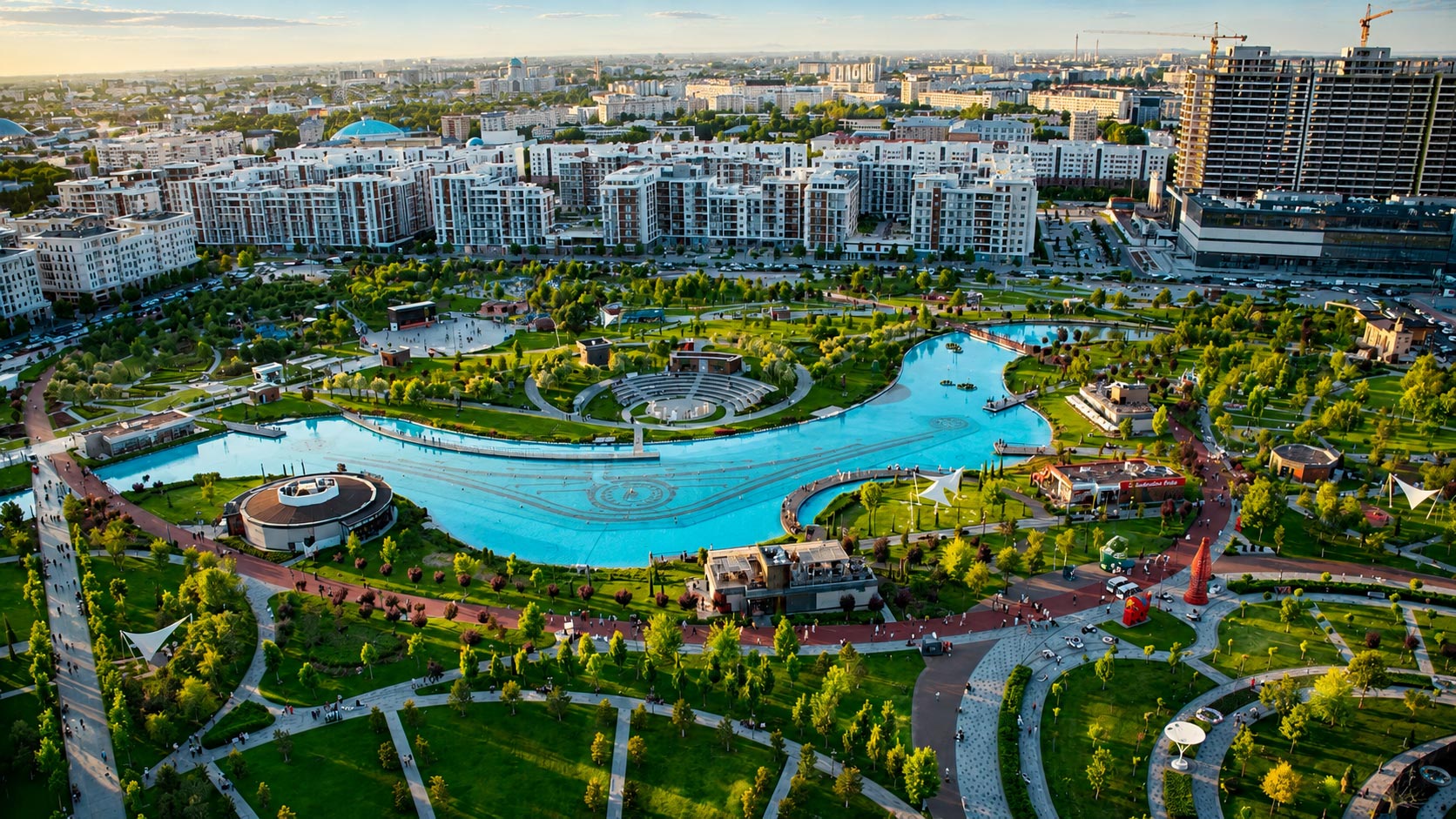
Square which bears the name of Amir Temur-centre of modern Tashkent,where monument of Amir Temur rise.Who was an outstanding political personality and ruler of Medieval century,who created huge empire,which lied from Caucasus to China and from Siberia to India,existing 200 years in XIV-XV centuries.Inscription on the plinths says: “Power in justice” in four languages.Square presents radial annular system consisting of 8 alleways,which give the beginning to the same number of streets,oriented by parts of world and diverging fanned out from Amir Temur’s monument,intersecting with ring roads in the centre of city.Ilkhom Dzhabbarov is an author of Amir Temur’s monument. Amir Temur square is surrounded by hotel “Uzbekistan”,buildings of Institute of Law(former secondary schools for girls),Amir Temur’s museum,famous Tashkent Chimes and one of the largest architectural constructions in Tashkent-Palace of Forums.Palace of Forums was built in autumn 2009.It became a place for holding state and international events,for example such as SCO summit.Palace of Forums impresses not only with its architecture,but also with its sizes.The building’s square is almost 10 thousand square metres.Outside Palace of Forums is decorated by great columns,but the most remarkable part of the building’s architecture is its dome.It reaches almost 48 metres in height,on the top of dome there is a figure of stork.Almost all buildings located around square have huge historical value .One of which is the building of Institute of Law.It is situated in front of Amir Temur square and is a historical monument of XIX century.The building itself was built by the order of Turkestan general-governor Kaufmann.It was a secondary school for girls for a long time.In Soviet Union reign the building was given to Tashkent state University.On the left side of building there was located historical faculty,on the right-law.After independence the building was entirely given to Institute of Law.Amir Temur’s square is one of the most favourite place of all citizens despite their age.Cinema and entertainment places are located not far away from square,it plays a significant role in constant popularity of this place.Square leads to roads of all parts of the city,which makes it the most relevant place for meetings.The history of modern Tashkent is inseparably coherent with its centre-Amir Temur’s square.
Prince Romanov’s residence
One of the atypical monuments of Tashkent is prince Romanov’s residence,which was built in 1891 based on the project of architects: A.L Benua and V.S Geintselman in the centre of the city.This is a one-floor building of Nicolai Konstantinovich Romanov-grandson of Russian emperor Nicolai I,sent by his royal parents to Tashkent in 1877 and who lived there till death in 1918.The building of residence was built in fashionable for that times style “modern”.Dainty house is decorated by carved bars,windows of unusual shape,towers and other decorative elements.Prince was impassioned hunter that’s why front doors were decorated by bronze figures of deers and hunting dogs.From the back side of the building there was an exit to a broad garden,made by famous Tashkent botanist and pharmaceut I.I.Krauze.Special attention was given to internal lining of palace.Halls were paneled with dark oak,decorated with carved ledges and golden inscriptions.Three doors from main hall lead to prince’s and his spouse’s room.On the left side of house there were billiard room,library,dining room,while on the right – greenhouse and Japaneese garden.In one of the outbuildings,Russian prince established menagerie,where wild animals were gathered.On Sundays menagerie was opened for public visiting.Nicolai Konstantinovich was popular among local people.He opened first cinema and bakery in the city,and built princely soldiers’ sloboda in the centre of city,built irrigation canal in Hungry prairie.Over the years,in Tashkent,prince gathered unique collection of antique and books,which were bequeathed to the whole city.After his death house was established as Arts museum of Uzbekistan,later museum of antique and jewelry art of Uzbekistan,in Soviet times it was –Pioneer Hall.At the end of XX century it was reconstructed and nowadays it is used as a Guest house for Ministry of Foreign Affairs RUz.
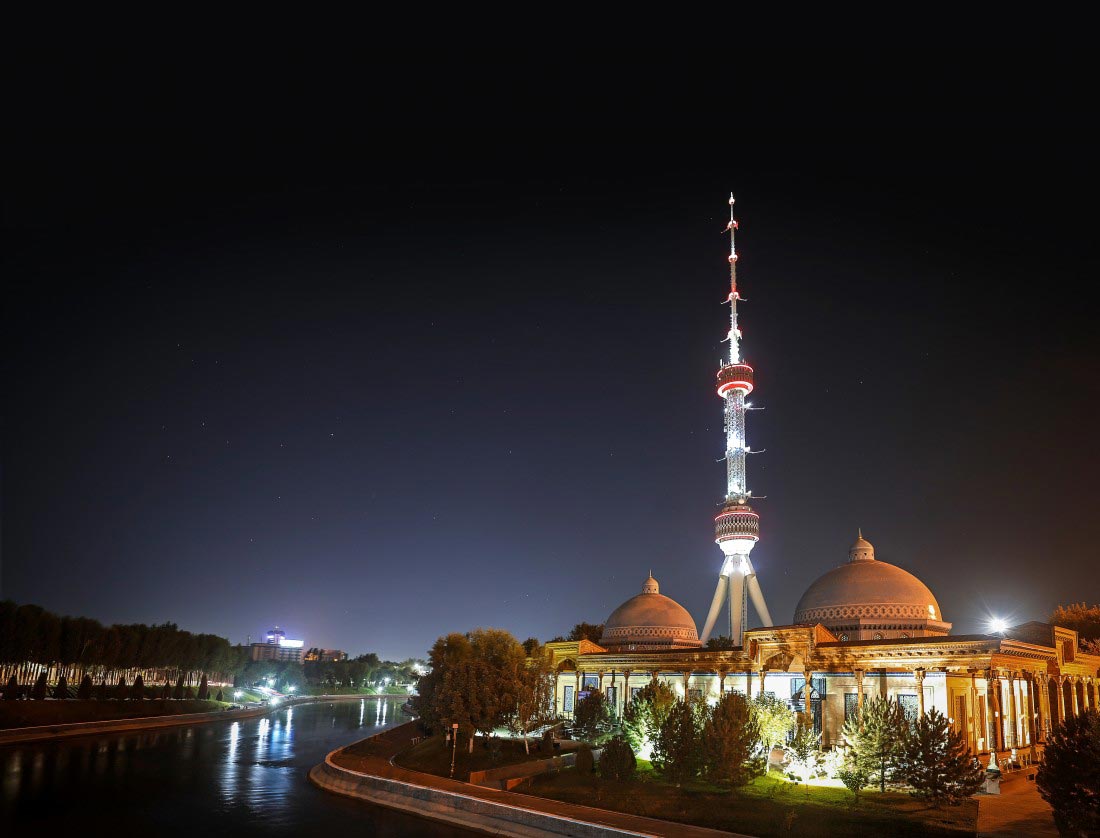
Tashkent Television Tower
Tashkent Television Tower is the highest building in Central Asia.It’s height reaches 375 metres,and it’s weight is about 6000 tonnes.It’s ranked on 11 place among high towers over the world.It was brought into operation on January 15th,1985.In 1991 it was included in the Federation of Greatest towers of the world ranking 11th place among more than 200 towers all around the world.Simultaneously it is the only one high tower in Central Asia and takes second place among CIS countries after Ostankino tele-tower (Moscow).Main functional tasks of Tashkent tower are TV broadcasting and Radio broadcasting.It is also used for liasing by many ministries and agencies,commercial organizations,complex station of high-rise observations under uzbek Hydrometeorological Service centre is also established there.As unique architectural construction,television tower of Tashkent is a visiting place for many citizens and guests of capital.Hosting of visitors is done by guided tour service.Highly- classified tour guides make excellent excursions about the history of creation of television tower and monuments of Tashkent city in Uzbek,Russian and English languages.The tower’s lobby is decorated with mosaic panel,made by master A.Burkhanbaev in Florentine and Rome styles.Unique construction of television tower was developed by architects: N.G. Terziev-Tcharukov,D. Semashko, also engineers E.P. Morozov and M.D. Musheev.Hall also presents all models of towers,which are included in Association of all Great Towers of the world.
There are established three high-speed “Schindler” elevators, which rise visitors on the height of 100 metres(speed is not less than 4,8 metres per second).
From viewing platform (100 metres)visitors go up to the “Koinot”(Space) restaurant,where two comfortable halls of restaurant : national “Blue” (height 105 metres)and European “Red”-can welcome simultaneously 120 visitors.In both halls of restaurant platform-floor with seats spins around tower’s trunk.National and European dishes are cooked in the hall of restaurant by visitor’s request.Bar of the restaurant includes variety of drinks.It includes live music.
Sitting here at a beautifully decorated tables, spinnig around on a height of 120 metres during 1 hour, visitors can enjoy the most beautiful view of Tashkent city.
State Academic A.Navoi Theatre of Uzbekistan
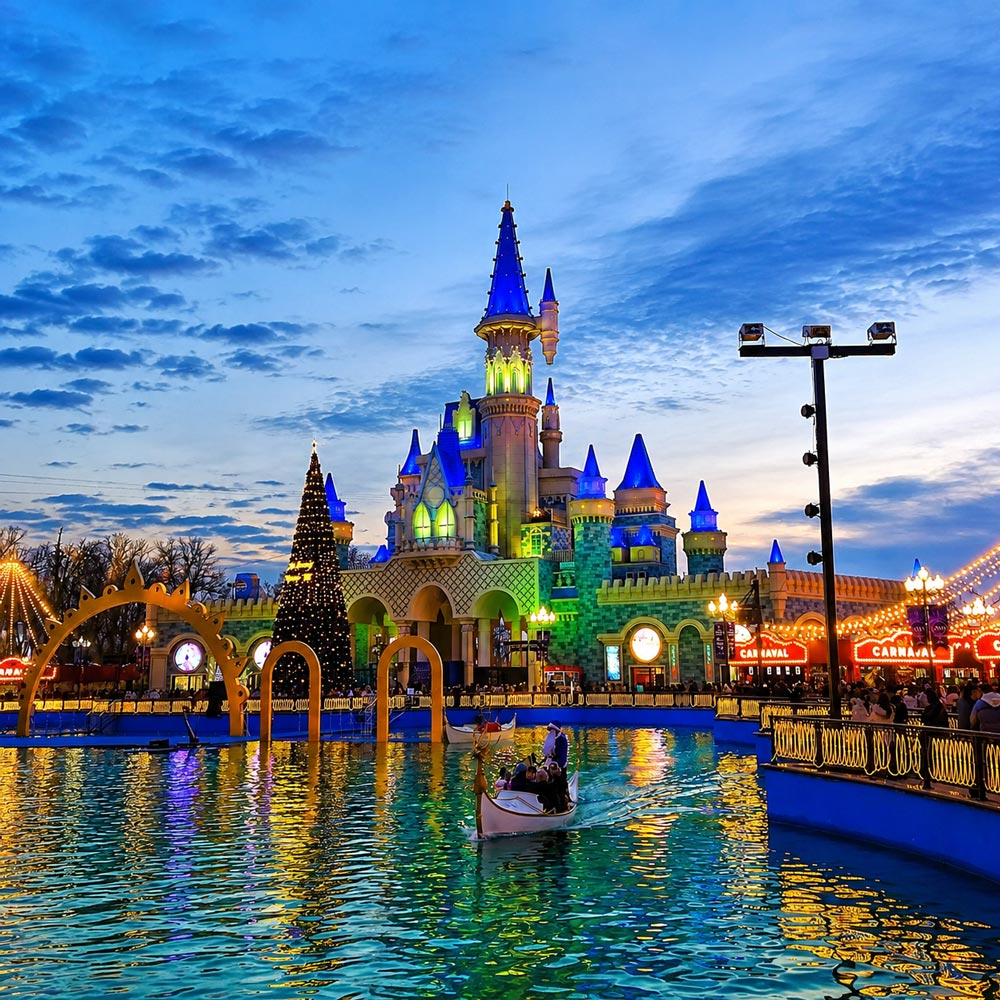
State Academic A.Navoi Theatre is the only biggest theatre on the whole territory of Central Asia and South-Eastern Asia .Its achievements-are great heritage of Uzbek people,nation’s pride.
Theatre’s history
It was founded in 1939 at the base of uzbek musical theatre.Theatre’s history begins from 1929,when amateurs of concert-ethnographic ensemble under the head of Mukhitdin Kari-Yakubov,singer,ensembel’s head organized professional theatre,dance group was headed by Tamara Khanum(Tamara Khanum-soviet uzbek dancer,singer,actress,choreographer.National artist o USSR). Premiere of first opera “Buran” on June 11,1939 triggered the development of national musical theatre.Opera,which was presented by stage director Emil Jungvald-Khilkevich gained the attention of all spectators and critics.Listing pages of history of it’s creative formation and development,we can be sure that as well as carrying out it’s important misson of intercoursing masses to world and national musical culture,the theatre also tries to extend it’s importance,to take a worthy place on world’s cultural stage.Working towards it,successful tours of the theatre abroad are being held,artists are taking part in international festivals and competitions,interesting international projects are being materialized.For the last three years such conducters as : Seim Akchil,professor of Istanbul Music University,three times- Pierre Dominique Panelle from Germany,Lawrence Hollan from USA,Paolo Longo from France,Giovanni Guerriere from Italy -were received as a guests on its stage.The stage also received opera singers from Korea and Japan,ballet dancers from Japan,Russia,Ukraine,France and Great Britain.
Wide foreign perspectives are reachable now for our specialists.Theatre’s Big symphony orchestra recorded its first disc in Malaysia,during five years ballet troupe was helding a number of exchangeable tours with “Toyota-city ballet” troupe(Japan),tutoring teacher of ballet national artist of Uzbekistan V.Proskurina was invited to work in “Toyota-city ballet”,main choreographer of theatre national artist of Uzbekistan I.Yusupov was invited on presentation of “Nutcracker” ballet in Turkey,famous ballerina,national artist B.Karieva,a number of times was a juror of grand competitions of young dancers in Italy and USA.
As for art aspect theatre’s troupe is in constant search ,quarterly renews and adds up its repertuare. In search of new forms and ways of realization of forwarding ideas of opera and ballet art,uzbek theatre surely goes forward.
Theatre’s unique building and fountain
In period of its creation and formation,as a professional,theatre of Uzbek musical collective didn’t have its own theatrical building. National architecture wasn’t skilled enough in building secular municipal buildings,especially such huge,where it would be possible to allocate significant number of spectators and make perfomances. In only,constructed at the beginning of XX century cultural institution – in the building of former “Colizeum” theatre- in 30’s were working two troupes of Russian and Uzbek musical theatres.Perfomances were shown every other day.Despite the reconstruction of stage and building, hall didn’t respond to requests of big classical and national spectacles.By the authority of Repubic of Uzbekistan it was decided to construct theatrical building,which would fit into the growth of national cultural upgrade,which Republic was facing in 30’s of XX century.State competition was announced on the creation of project of theatrical building with condition of publication the projects in press and their wide discussion and public evaluation.According to the results of competition project of architecture academic A.V. Shusev won the competition.It was considered to fulfil all functional tasks and national traditions in architecture. In 1939 the construction of building officially starte,it was stopped in 1942 because of difficulties linked with military situation.In 1944 construction of the building was renewed.In November 1945 Japaneese war prisoners from Quantum army were deported to Tashkent,they took part in final step of constructional works. National artists of Uzbekistan-Usta Shirin Muradov,A.Khudaibergenov,X.Boltaev and others-demonstrated their great skills in lining works.By design of authors’ projects each sideway,6 in all- had a way of architectural décor inherent to a particular region of Uzbekistan.Following halls have their own style and features:Tashkent hall,Bukhara hall,Khorezm hall,Samarkand hall,Fergana hall and Termez hall.For example,for Bukhara hall it was chosen to carry out such unique décor technics as ganch carving,superimposed on a mirror surface.Such element of décor was firstly used in construction of Bukhara’s Emir palace.Khorezm hall is decorated by carved panels from ganch,repeating remarkable wood carving,which patterns with Khorezm.Halls and lobby of the theatre are decorated by wall paintings on the plots of A.Navoi’s poems and illustrating sceneries of Uzbekistan.Ch.Akhmarov and A.Tatevosian are the authors of paintings.Once the construction of theatre was over,Shusev suggested to put a fountain in front of theatre.This ended the creation of architectural ensemble,which became capital’s wonderful décor.
In 2010 the fountain was reconstructed,new illumination and soundtrack were added- and now it is coloured-music “dancing” fountain,which gathers a lot of people around it.
From the opening day in 1947 it was not only the building where wonderful spectacles took place, but a place where solemn occasions of Uzbekistan were held.This tradition continues till nowadays.Many foreign representatives consider as an honor to hold their events on the stage of theatre.
Independence square
Independence Square(“Mustakillik Maidoni”) is not just only central landmark of Tashkent but also unique city symbol,where national events take place and it is favourite place of citizens to go for a walk among refreshing flows of fountains along green alleyways.As well as other Tashkent’s regions Independence square has its own history.Till 1865 not far away from this place there was located palace of Kokand khans.In 1865 Kokand khaganate was liquidated and close to ruined palace by the order of Russian administration,construction of Turkestan Governorate-general was started.Subsequently this residence with broad garden was called as White House.In a colonial period on the parade ground forces were reviewed.
In Soviet times the square was renamed as Lenin’s Square.Lenin’s monument was established in the centre of square.Right at that times the construction of new fountains and installation of the square itself started.
After Independence in 1991 Lenin’s Square was renamed to Independence square( Mustakillik Maidoni)(1992).Lenin’s monument was demolished and new monument of Independence was established.It has a figure of Globe where Uzbekistan is highlited.
Nowadays Independence Square-is a place for holding ceremonies such as Independence Day of Uzbekistan (September 1) and New Year (January 1).During celebrations Independence Square is visited by all Tashkent citizens,since it is possible to see perfomances of artists,clowns and wirewalkers.By the New Year High New Year tree is being mounted on the square.
After general reconstruction,which was held on the square,many buidings were restored and acquired modern look.The central monument of square- 16 marble columns,united by overlapping,where storks’ figures are mounted.Storks symbolize peace and serenity.Alleways, from both sides of which it is possible to see places with fascinating fountains,lie from colonnade right to the Monument of Independence.Under the monument,there is a figure of woman with a baby in her hands,who symbolizes Motherland.
Square’s size is almost 29 acres.State buildings and Administrative establishments are located on the square.To the south from the Monument of Independence the Senate’s Chamber is located.Before Alisher Navoi’s library was used to be located on that place, but in 2003 it was removed to other place,whereas new building of Upper House of Parliament of Uzbekistan was built.The building itself was constructed in classical style ,the front entry presents columns with porticos.In front of Senate’s building,on the side of colonnade state establishments are situated.The chamber of ministers of Uzbekistan is also located on the square.
On the opposite of Administrative establishments,from other side of central colonnade,there is a park.Walk of Fame is located there in honor of deceased warriors of II World War.From both sides of alleyways there are galleries,which are decorated with carved wooden columns.Books of memory with names of Uzbeks, who died in War are located in that alleyways.
Alleway ends with the figure of Grieving Mother ,in front of which there is an Eternal Flame.Every 9th of May it is a tradition for citizens to come and place flowers to the monument of Grieving Mother.Park borders on the city river channel Ankhor.It is a favourite place of rest for Tashkent citizens.
Tashkent Metropolitan
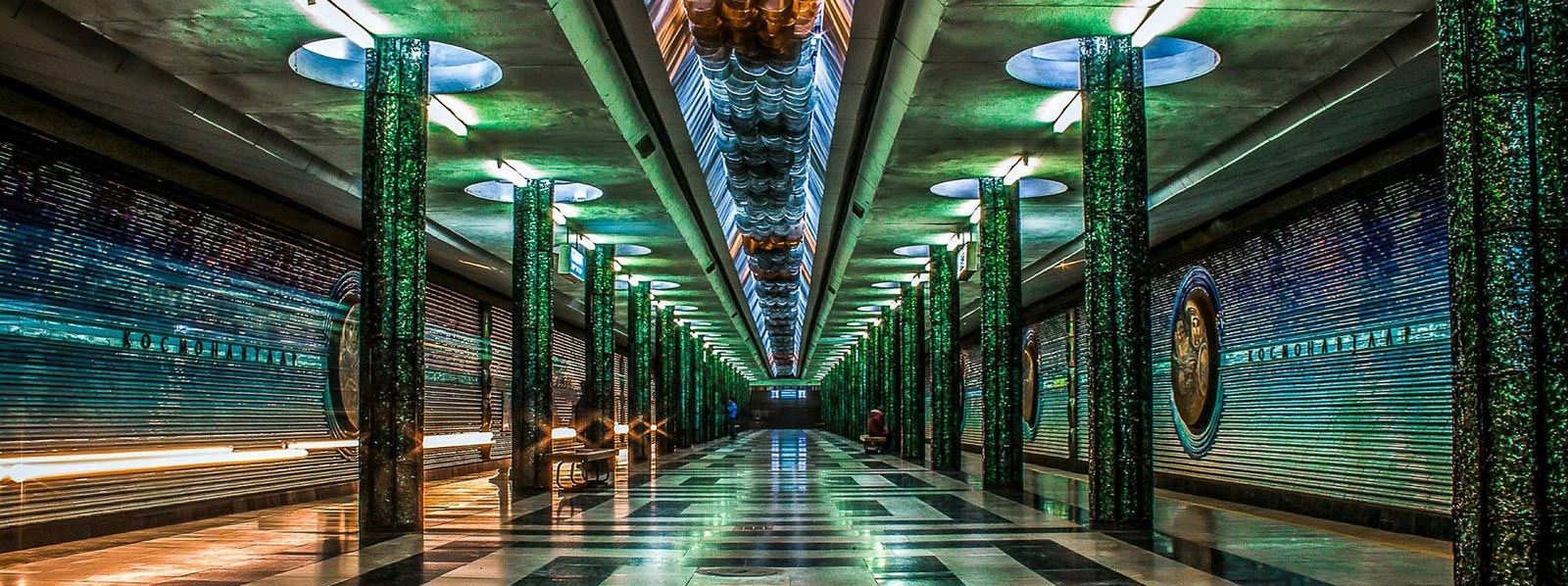
Nowadays Tashkent is a modern capital of Uzbekistan.Unfortunately it can not boast with a great number of architectural monuments unlike Samarkand,Khiva and Bukhara.But in this densely populated city not only of Republic,but also of the whole Central Asia, it has its own landmarks.One of which is Tashkent Metropolitan.Its construction started when the city was restoring from terrible earthquake of 1966 year.And capital’s growing population needed fast and convenient public transportation.Already in 1977,in honor of the 60th anniversary of USSR,first subway line was opened.It connected the most densely populated region of Tashkent-Chilanzar with the centre of the city.
Reconstruction works were continuing and after several years the length of the line was prolonged once new stations were opened, and the second line was put into operation in 1991.In 2001 third subway line was opened ,which should connect the centre with another densely populated region of Tashkent – Yunus-Abad.Nowadays there are 29 operating stations in Tashkent.
All stations have their unique appearance: marble and granite lining,rows of columns,colourful bas-reliefs, ganch and etc.The illumination plays a significant role in station’s design.It creates the atmosphere of ballroom on one station and the feeling that you are in mysterious Catacombs on another station.Each station is a special landmark of Tashkent.That’s why citizens often see amazed faces of tourists and guests of capital,who are enthusiastic about subway.
Modern condition
Currently the length of three lines of subway with 29 stations is about 36,2 km.
However,it shoul be noted that the Tashkent subway-is a strategically important object and it is prohibited to take pictures and videos here.Finally,air conditioning system of the metropolitan is always ready to protect its guests from summer heat and winter cold.So that the travelling along this underground pleases anyone.
Japaneese garden
In the centre of Tashkent city,behind International business-centre at the hotel “Intercontinental” you can find a picturesque nature corner: unique “Japaneese Gartden”.It took this name because of its creators.Many old-timers remember more than semicentenial time(1947),when wasteland was forming into a park.Basin for park’s lake was dug by japaneese prisoners of war and possibly park’s trees were also planted by them.
More than half of century passed.Time heals injuries ,but it also sharpens memory.And as a memory-there are stones, and as a humility- there are flowers on alleyway gardens.Everything here calms down and lets to think about eternity and beauty,creation and mercy.
Parents with children come here to feed ducks swimming on the water surface of lake.It is nice to sit in the gazebo on the lakeside,wander along the garden’s paths in peace and quiet among the city noise.
You can see here countless numbers of wedding processions: “Japaneese Garden”-is a popular place for weddings,favourite place of newly-married couples who decided to capture the most significant day of their life on a beautiful background of nature.
It is mandatory to visit a tea-house.Before entering you definitely should spin national Japaneese drum in order to be heared by Gods.You should take off your shoes because of carpets.On the separated table there are all essential tea ceremony attributes which with ,you are allowed to take pictures,as for Japaneese national costumes they will complete the impression of being in little Japan,right in the heart of Uzbekistan.
Passing through the whole house you’ll find an open terrace without sides ,which goes to little ponds ,where carps and golden fish live.You can sit down on the edge of terrace and watch the playful games of fish in the pond.
Further,leaving the tea-house,you can path through wooden bridge,which lies above a bubbling brook and step on footpath where you can discover hidden corners of a huge garden.
Tashkent Botanical garden
The nature of our Earth is set pretty harmoniously.Each nature area has its own features and beautiful places ,each region is unique and fantastic.You will never find two identical valleys and rivers.Millions of years has made our Earth a wonderful place,which is full of infinite diversity of life.And sometimes we have to leave city noise in order not to lose our connection with mother nature.This is possible to do without leaving the city:many cities have unique nature areas.One of which is Tashkent Botanical garden.
History
In periods of Great Patriotic War,when people from USSR were evacuated to Tashkent and nearby cities,academician Fedor Rusanov suggested to open Botanical garden in the capital of Uzbekistan.In 50 years history thousand species of plants from all over the world were gathered here.Nowadays there are more than 4500 species of trees,flowers and other plants.The garden itself is divided into 5 parts ,which suit the Central Asian,Eastern Asian,North American and European flora,including Qrimea,Caucausus and Far East.It is possible to keep these species because of sharply-continental climate of Uzbekistan.
Botanical garden also includes greenhouses, and special arboretum for herbs.Species of exotic plants from tropical and subtropical countries are represented here.The most famous rare species in Uzbekistan are Metasequoia, Gīnkgo,Magnolia,Tulip tree,Japaneese apple pears,Erémurus,Bald Cypress,Iris and others.
Avifauna
In Botanical garden of Tashkent it is possible to see more than 30 nesting,flyway and overwintering species of birds,some of which are atypical for other territory of Tashkent :dabchick, Phalacrocorax pygmeus,Sparrowhawk,Buteo Japonicus,Pheasant,Water-hen,Ringdove,Scops owl,Kingfisher.
It should be noted that this garden is beautiful during all seasons: In spring the garden blossoms,in summer it is full of green and protects from heat,whereas in autumn-this is just a fabulous palette from bright-yellow to dark-red.It is possible to come here with friends or children to make picnics.School excursions and events of Uzbekistan ecologists are often held here.
By the way,it would be more interesting to walk with a guide:He will tell stories and legends of unique plants.It is indeed a magic place-you can fully relax.